
Max Townshend
Communication Engineering
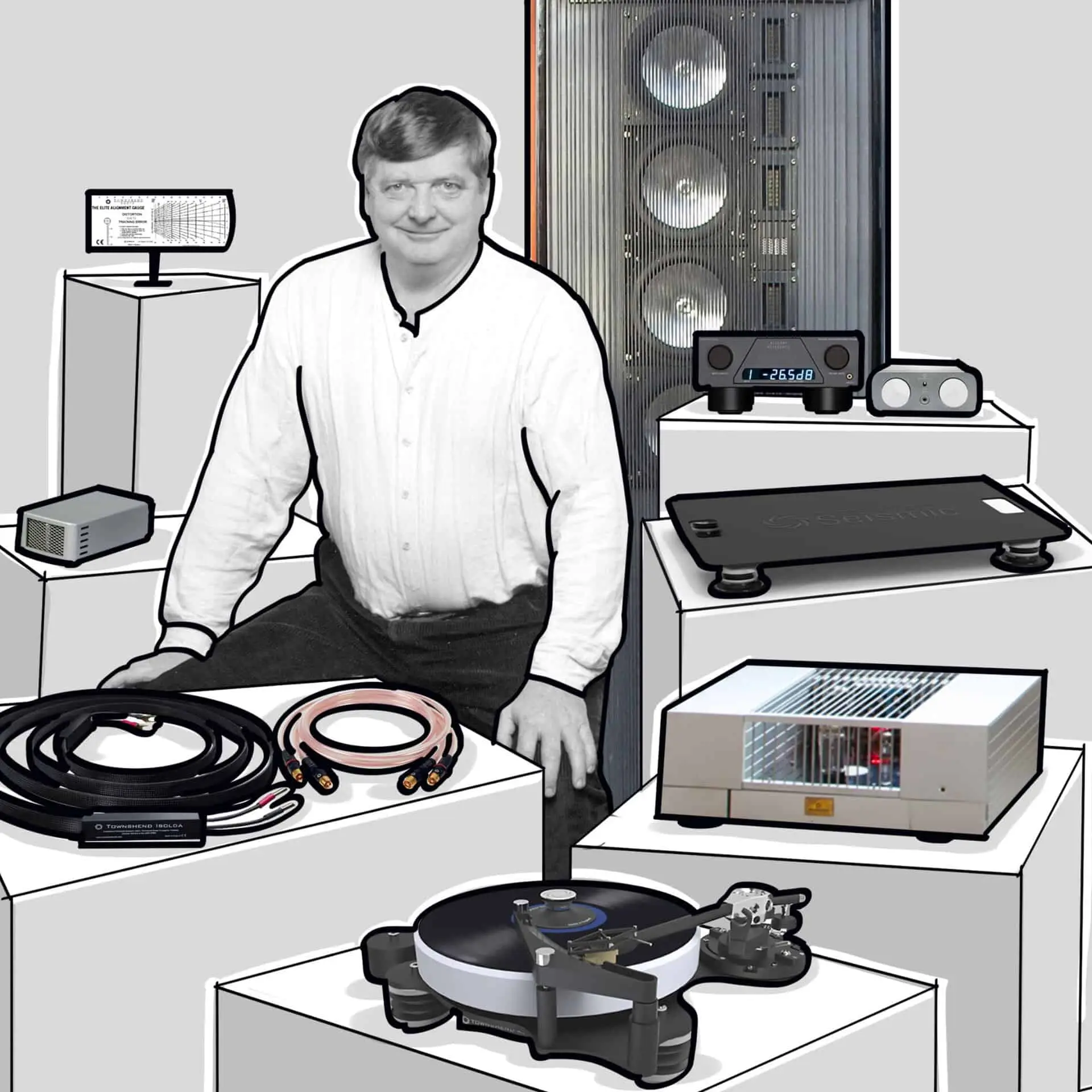
Max Townshend’s background includes a passion for electronics from a young age, studying communication engineering at university, and working in the Australian Airforce as an engineer, where he observed military isolation solutions that inspired his work in HiFi equipment isolation. His practical approach to engineering and willingness to question conventional wisdom have led to his unique perspectives in the audio industry.
Max Townshend was an Australian-born British audio engineer, inventor, and founder of Townshend Audio, a company renowned for its innovative contributions to high-fidelity audio equipment. A pioneer in the hi-fi industry, Townshend’s work spanned over four decades, introducing groundbreaking designs in turntables, preamplifiers, vibration isolation systems, cables, and loudspeakers. His relentless pursuit of audio excellence and unconventional engineering solutions left a lasting legacy in the audiophile community.
Early Life and EducationMax Townshend was born in 1943 in Perth, Western Australia. From a young age, he displayed a keen interest in electronics, which led him to pursue a Bachelor’s degree in Electrical Engineering from the University of Western Australia. After graduating, he served in the Royal Australian Air Force, where he managed technical instrumentation for anti-submarine reconnaissance aircraft. His early career also included engineering roles in Sydney, working on projects such as remote control systems for hydroelectric power stations and radar landing systems, experiences that honed his practical approach to problem-solving.Career and Townshend AudioFounding of Townshend AudioIn 1975, driven by a lifelong passion for music and audio reproduction, Townshend founded Townshend Audio in Sydney, Australia. Initially, the company focused on marketing parabolic diamond styli for record players, addressing a gap in the market for high-quality phono cartridges. In 1978, seeking broader opportunities, Townshend relocated the company to the United Kingdom, where it became a prominent name in the specialist hi-fi industry.Innovations and Product HistoryElite Cartridges and Parabolic Styli (1975)Townshend Audio’s first products were the Elite moving-coil cartridges, notable for featuring a parabolic stylus—one of the earliest designs to incorporate a line-contact stylus. These cartridges improved tracking accuracy and reduced record wear, establishing Townshend’s reputation for precision engineering.Townshend Rock Turntable (1980s)In collaboration with Professor Jack Dinsdale of the Cranfield Institute of Technology, Townshend developed the Townshend Rock turntable, launched in the early 1980s. This turntable introduced a revolutionary front-end damping trough—a paddle attached to the tonearm headshell submerged in a viscous fluid—to eliminate cartridge vibration and distortion. The Rock, with its heavy platter and belt-drive system, became one of the most radical turntable designs of its era and remained in production, through various iterations like the Rock II and Rock Reference, for over three decades. It was particularly praised for its exceptional bass reproduction.Glastonbury Loudspeakers (1980s)
Townshend ventured into loudspeaker design with the Glastonbury series, including the Glastonbury II and later the Glastonbury TOR. These speakers featured plaster-lined enclosures for rigidity and metal drivers for precise sound reproduction. The TOR model, an eighteen-driver, time-aligned design, exemplified his pursuit of innovative loudspeaker concepts.
In the late 1960s or early 1970s, Townshend worked as an engineer at Amalgamated Wireless Australasia (AWA) in Sydney, based at their North Ryde facility. His office was located next to that of A. Neville Thiele, an engineer developing the Thiele/Small (T/S) parameters—electromechanical metrics such as Qts, Vas, and Fs that define a loudspeaker driver’s low-frequency performance. Townshend’s workspace included tools like oscilloscopes and notebooks for designing loudspeaker or amplifier systems. Thiele’s adjacent office housed testing equipment, including valve amplifiers and frequency generators, and the two spaces shared a partition wall through which Townshend could hear Thiele’s tests and discussions on speaker parameters. Townshend was among the first designers to apply T/S parameters to loudspeaker design, an influence that later appeared in his work with Townshend Audio. Seismic Sink and Vibration Isolation (1989)In 1989, Townshend introduced the Seismic Sink, the first widely recognized vibration isolation platform for audio components. This air-based isolator decoupled equipment from environmental vibrations, enhancing sound clarity. This concept evolved into the Seismic Isolation Platforms, Podiums, and Pods, which used spring-based systems to isolate everything from turntables to loudspeakers. Townshend’s advocacy for decoupling speakers from floors—contrary to the prevailing practice of spiking—marked a paradigm shift in audio setup philosophy.Impedance-Matched Cables and Cryogenic Treatment (Late 1980s – 1990s)Townshend pioneered impedance-matched speaker cables in 1978 and later introduced the Isolda cables, featuring flat ribbon designs and cryogenic treatment to enhance conductivity. His next-generation Fractal treatment further refined this process, pushing cable performance to new heights. He challenged conventional wisdom by arguing that transmission line effects were relevant at audio frequencies, even with short cable lengths.Ribbon Supertweeters (1990s)Townshend’s ribbon supertweeters extended the high-frequency range of existing speaker systems, improving soundstage and detail. These became a popular upgrade among audiophiles seeking to enhance their setups without replacing core components.Allegri Passive Autotransformer Preamplifiers (2000s – 2021)One of Townshend’s most acclaimed innovations was the Allegri series of passive preamplifiers, starting with the Allegri+ and culminating in the Allegri Reference. These units used autotransformers to match impedances between source and amplifier, eliminating active circuitry for unmatched transparency. The Allegri Reference, refined over a decade, is widely regarded as one of the finest preamplifiers available, reflecting Townshend’s belief that volume control was the weakest link in audio systems.Later DevelopmentsUntil his death in 2021, Townshend continued innovating, working on projects like a revised Glastonbury loudspeaker and exploring ways to transform budget electronics—like modifying a Pioneer DVD player into a high-performance CD player. His final years saw an accelerated pace of development, with new products in the pipeline for Townshend Audio.Philosophy and ImpactTownshend’s engineering approach blended rigorous science with a willingness to challenge established norms. His belief in ultra-wide bandwidth, skepticism of digital audio’s limitations, and focus on vibration control set him apart. He was known for practical, affordable solutions—like suggesting squash balls for component isolation in the late 70s—alongside his high-end designs. His gregarious personality and ability to explain complex ideas made him a beloved figure in the hi-fi community. Townshend was married to Sue Townshend and had two sons and a daughter. A bon viveur, he enjoyed fine wine, good food, and driving Citroën cars, particularly the C6, for their advanced suspension systems. He passed away on December 31, 2021, at age 78, leaving behind a thriving company run by his family.LegacyMax Townshend’s innovations transformed how audiophiles approach sound reproduction, from vinyl playback to system isolation. Townshend Audio continues to operate, carrying forward his vision with products he designed in his final years. His contributions earned him accolades as one of the greatest audio innovators of his generation, with a lasting influence on high-fidelity audio worldwide.